Solving slope challenges, creating level garden terraces, and protecting your property from erosion. Concrete block and timber sleeper walls built properly — with drainage — to last for decades.
Retaining walls are one of the most common landscaping requirements across Adelaide's southern suburbs. The hilly terrain at Hallett Cove, the sloped blocks throughout Morphett Vale and newer developments, and the challenging ground conditions in Hackham and Reynella all create situations where a well-built retaining wall is the only practical solution to unlocking your outdoor space and protecting your property long term.
At Maddern's Place, we build retaining walls using concrete block and treated timber sleepers — materials proven in Adelaide's climate. Every wall is designed for the specific site: the height and load requirements, the soil type, the drainage demands, and the visual outcome. We don't cut corners on the foundation work or the drainage layer behind the wall, because those are the two things that determine whether a wall lasts 5 years or 40.
Our projects range from small garden steps and raised bed edging right through to large-scale structural walls on steeply sloped blocks. Whatever the scale, we apply the same level of engineering care and quality workmanship to ensure your wall performs exactly as it should for the long term. We've built walls across dozens of properties throughout Adelaide's south, and every one is still standing.
Most retaining wall failures are caused by skipping or shortcutting one of these steps. We follow this process on every job, regardless of wall size.
We visit the site to measure the height change, assess soil conditions, identify any drainage issues, and determine the appropriate wall type and materials. For walls over 1 metre we also advise on any council requirements. The assessment informs the design — footing depth, drainage approach, and whether block or sleeper is more appropriate for the specific site and budget.
The base trench is excavated to the correct depth for the wall height — typically 200–300mm below grade for smaller walls, deeper for taller structural walls. Correct footing depth is non-negotiable: a wall built on an inadequate footing will move under soil pressure over time. The base is levelled and compacted to create a stable, consistent platform before concrete is poured.
A concrete footing is poured and levelled at the base of the wall. For block walls this provides the flat, stable surface that the first course sits on. For timber sleeper walls, the concrete base anchors the posts. Allowing the footing to cure properly before beginning construction is important — rushing this step causes problems later.
Before any wall material goes up, we install the drainage system. This consists of agricultural drainage pipe (aggi pipe) along the base, surrounded by 50mm blue metal aggregate to allow water to flow freely, with geofabric lining the back face of the trench to prevent soil from migrating into the drainage layer. This step is what separates walls that last from walls that fail. Hydrostatic pressure — water pressure building up in waterlogged soil behind a wall — is the single most common cause of retaining wall failure.
Block or sleeper courses are built up systematically, checking for level and alignment on every course. For concrete block walls, we batter the wall slightly (lean it back into the soil) to improve the structural angle against soil pressure. Taller walls may include reinforcement. Sleeper walls use galvanised posts with sleepers stacked and secured correctly. Every course is checked before the next one goes on.
Block walls are capped with matching capping units for a clean, finished top edge. The drainage aggregate is topped up behind the wall, then the wall is backfilled with suitable fill material, compacted in layers to prevent excessive settlement. The site is cleaned up, levels are checked, and the finished wall is walked past for any touch-ups before we call the job complete.
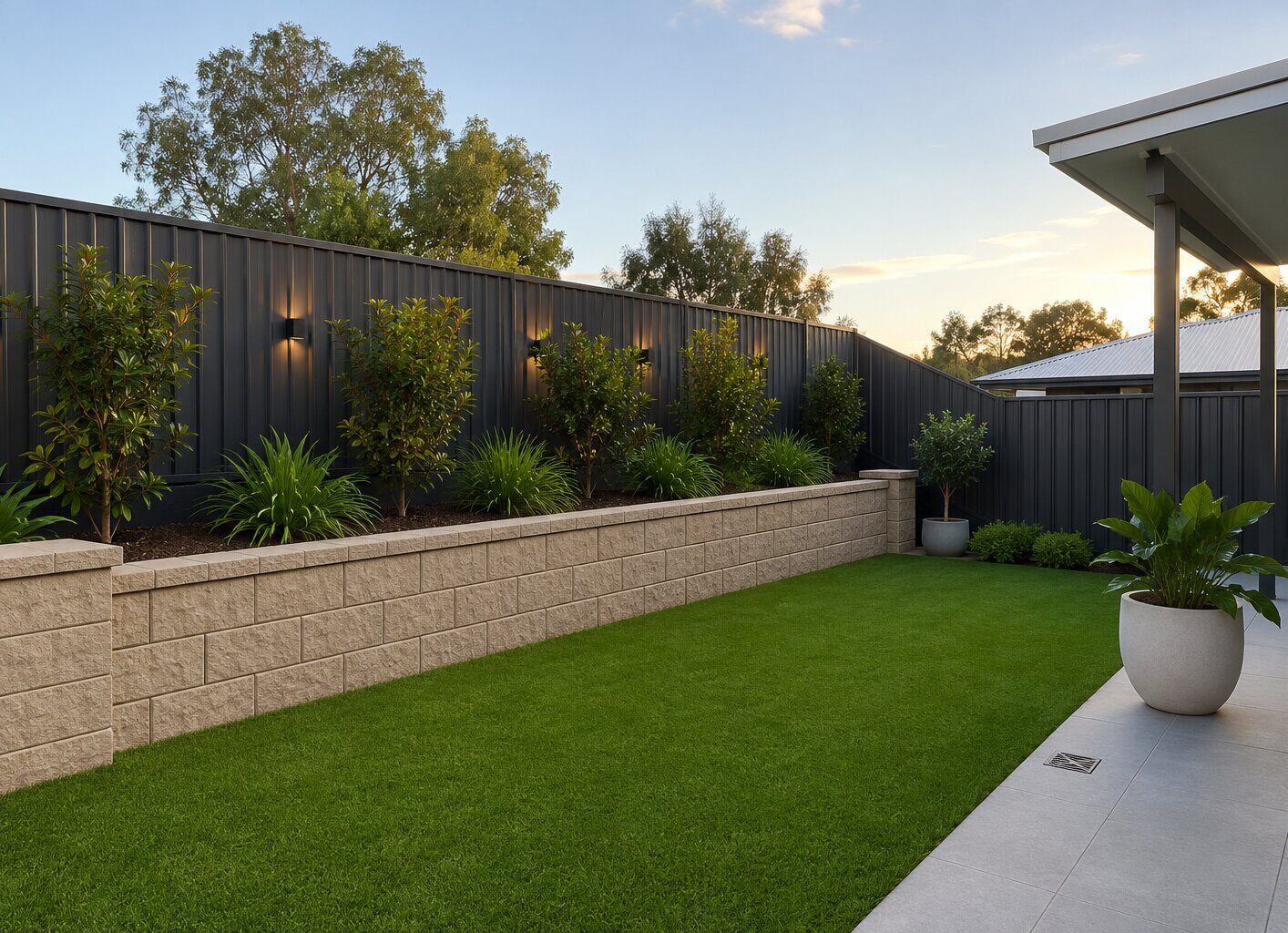
Durable, long-lasting block walls using quality Adbri masonry products. Best for larger height changes, high-load situations, or anywhere maximum structural strength and longevity is required.
Treated pine sleeper walls — cost-effective and natural looking, well suited to garden bed edging, smaller height changes, and informal terracing where a warmer aesthetic is preferred.
Every wall we build includes agricultural drainage pipe, 50mm aggregate, and geofabric. This is non-negotiable — it's what determines how long the wall performs without movement or failure.
Correct footing depth and a concrete base on every wall, sized for the height and soil conditions. The most critical structural element — and the one most often skipped by inexperienced builders.
Transforming steep slopes into multiple flat, usable terraced areas — creating lawn space, garden beds, and outdoor living zones where previously there was nothing but unusable hillside.
Clean capped tops, straight lines, and a tidy finish. The structural work is done properly from the ground up, and the visual finish matches — we take the same care with appearance as we do with engineering.
Adelaide's southern suburbs are far from flat. From the coastal cliffs and elevated streets at Hallett Cove to the hillside addresses in Morphett Vale and the undulating terrain throughout Happy Valley and Aberfoyle Park, sloped blocks are a fact of life for many homeowners in this area. Without proper retaining, sloped ground creates cascading problems — soil erosion, unusable garden space, and water running toward the house rather than away from it.
We frequently encounter retaining attempts that have failed — walls built without proper drainage, using materials not suited to Adelaide's clay soil conditions, or without adequate footings for the actual soil pressure they were bearing. When moisture builds up behind a wall with nowhere to go, the pressure eventually causes bowing or outright failure. Our builds start with the engineering fundamentals that prevent this, because fixing a failed wall costs far more than building a correct one the first time.
Adelaide's clay soil also expands significantly when wet and contracts in summer heat — a cycle that puts real stress on retaining structures year after year. Our drainage systems relieve hydrostatic pressure before it builds, and our material choices account for this expansion and contraction. A well-executed retaining wall genuinely adds value to your property: terracing a sloped block creates flat, usable lawn space and garden areas that transform what was an unusable slope into the best part of the backyard.
Sloped blocks are common across Adelaide's south — we know the soil conditions, council requirements, and site challenges in each area.